

Energy from above
Solar panels on warehouse buildings
For years, advocates of solar power have been promoting the use of otherwise unused warehouse and commercial roof space. At first glance this is attractive, but a number of factors need to be considered.
The drive towards renewable and carbon-free energy sources is accelerating, propelled by several pressures.
First, there is the general drive to reduce carbon emissions, which weighs particularly heavily on the manufacturing and logistics sectors, as these activities are generally carbon-intensive, or at least more intensive than, say, financial services.
Second comes consumer pressure... Increasingly, consumers not only want to hear that the products they buy have a low environmental impact; they want to see the evidence.
Third, energy costs – which have soared since the most recent armed conflicts – have lent the situation a degree of urgency. Security of energy supply has become vital; businesses simply cannot afford unplanned interruptions. Demand will continue to grow, and relentlessly so. Automation is increasing the energy consumption of commercial buildings, while the electrification of transport is increasing the pressure on electricity grids across Europe.
As conventional oil- and gas-fired power generation has become more expensive, alternative energy sources have become more commercially viable.
Look up
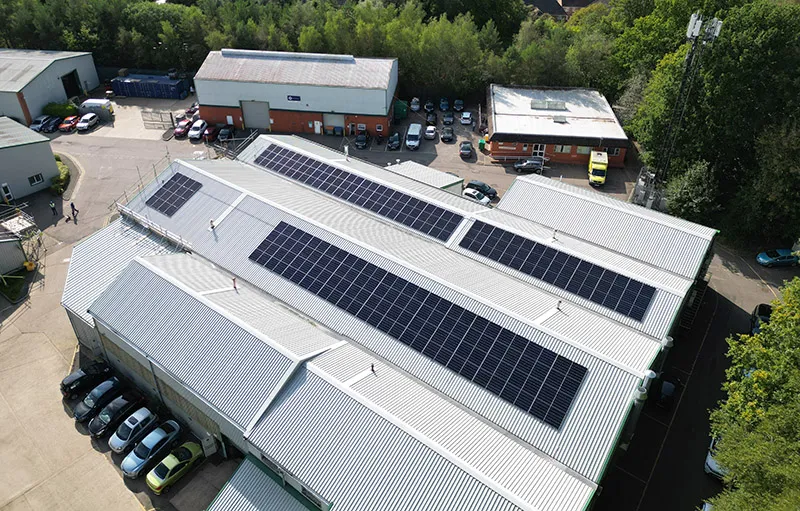
Wind turbines have become established tools for electricity generation and a familiar sight at commercial sites. There is growing enthusiasm for the argument that logistics operations should aim even higher. One area that still remains largely untapped for generating carbon-free energy is warehouse roofs.
Warehouse buildings have very large roofs, which in theory should be ideal places for harvesting the energy of solar radiation and generating photovoltaic (PV) power – which is what solar panels are for. It is estimated that up to 25% of Europe's electricity needs could be met by rooftop solar panels.
Checking suitability
But not every building is suitable for photovoltaic solar systems; after all, these structures are heavy. Choosing the right site is therefore not always a simple or straightforward process.
Tax savings
Is it worth investing time, effort and capital in installing a solar system? That depends on several factors. One immediate attraction in many European countries is that electricity generated "behind the meter" – i.e. not from the grid – is not subject to VAT, IVA, green taxes or carbon taxes.
However, the attraction of "behind the meter" generation depends on how grid electricity is charged. In the United Kingdom, the usual structure is a relatively low standing charge with a high – and fluctuating – unit cost. With a unit rate of 25 pence, typical for commercial supply, solar power can deliver significant savings. At the other extreme is Spain, where standing charges are often high but unit costs are low, which means solar power offers no advantage. This goes a long way to explaining why, in one of Europe's sunniest countries, building roofs are not covered in solar panels.
Light and energy
Solar panels are rated according to the amount of energy they can generate under ideal conditions. In central France, southern Germany, Austria, Hungary and Slovakia, around five square metres of panels produce 1,100–1,200 kWh a year. In southern England they can produce around 1,000 kWh/year. In northern Scotland and much of Scandinavia, the same output may be around 700–800 kWh/year.
In countries at higher latitudes, such as the United Kingdom and the Scandinavian countries, sunlight is less intense and less usable; in general, the further north you go, the less attractive solar power becomes. In the depths of December, there are a few days in northern Finland, Sweden and Norway with no usable sunlight at all. In northern Scotland the sun shines for less than six hours, which means that the spaceport planned in Sutherland is unlikely to be solar-powered.
This does not mean that solar power should be dismissed at higher latitudes. GLP has 700 megawatts (MW) of installed solar capacity across Europe, which contributes significantly to its drive to reduce carbon emissions. In practice, the business case depends on the cost of grid electricity, even for a single building.
Spain, southern Italy and Greece are likely to offer higher levels of solar generation, and Turkey and the Middle East higher still. In North Africa and the Middle East, however, it must also be borne in mind that – paradoxically – the efficiency of solar panels falls when temperatures rise above 40⁰C. This does not reduce efficiency to the level of dark northern climates, but it can reduce it significantly. In future, new solar panel materials may improve efficiency and allow peak output across a wider range of temperature and light conditions.
Needs must match the technology
Potential users also need to consider what their energy needs are. Offices and low-demand equipment – including heating, ventilation and air conditioning – can meet much of their needs from a solar system, as can uses with constant energy demand, such as printing, cold stores or data centres. However, it is unlikely to be very useful in applications where demand fluctuates significantly, such as rapid charging of an electric vehicle fleet, unless some energy storage capacity is also available so that solar generation can "buffer" the demand. (Energy storage is an important consideration if a site wants to be self-sufficient and off-grid.)
The on-site energy network must be appropriately sized and fit for purpose. There will be some needs that can only be met from the grid. In a windy area with long periods of darkness – such as northern sites – there would be greater reliance on wind to supplement grid power.
There is no single answer to the burning question: is it right for me? It depends. But there are plenty of resources available to help you better judge whether your building will deliver a return on your investment, and how quickly. It is not just about energy: it is also about carbon footprint and ESG (environmental, social and governance) performance. Price pressures, fluctuating supply and legislative pressure to improve buildings' EPC (Energy Performance Certificate) ratings mean that it is worth exploring the options to help identify the best approaches.