
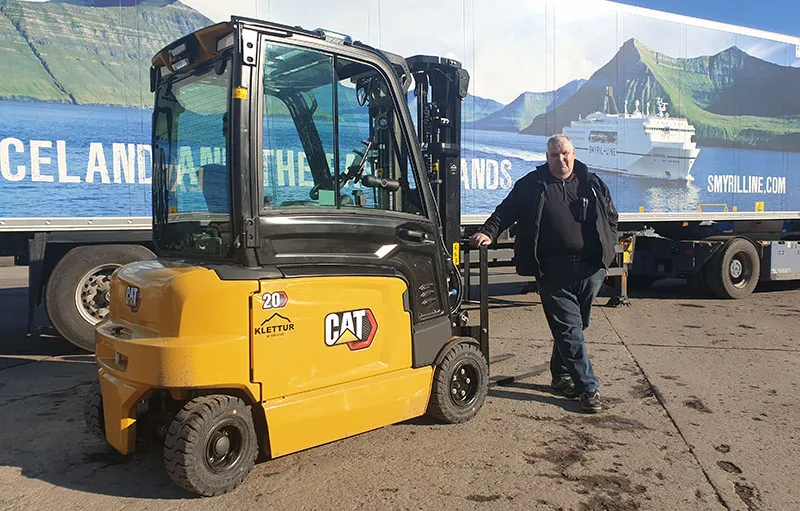
If there is one piece of equipment you can find everywhere, it is the trusty forklift. But not every forklift is lucky enough to work in a warm and friendly environment. Today we look at some of the most hostile conditions for materials handling equipment: those in the fishing industry. We examine what suppliers and forklift users can do to prevent breakdowns and protect forklifts against premature ageing in these harsh conditions.
Across Europe, the fishing sector – from large fish producers to local fish market suppliers – has had to contend with difficult market conditions. More and more regulations have to be complied with, for example on fixed quotas, fishing areas and the maximum number of days at sea. There is growing pressure from consumers and governments alike to avoid overfishing and protect our planet. "Sustainability" has quickly become a buzzword. Recent uncertainties arising from issues such as Brexit and the coronavirus have also made themselves felt.
Despite all this, global demand for fish and seafood continues to grow. A number of reports, such as one by the major Dutch agricultural bank Rabobank, predict a significant increase in fish consumption worldwide. Demand for high-quality fish and seafood is particularly strong in the United States, the European Union and China.
How forklifts keep their heads above water
According to Einar Løfgren, EAME business manager at Cat® Lift Trucks, the most demanding applications are found in various processing plants, storage operations and incoming ports. Here, fish must be handled at maximum speed for hygiene reasons. The further up the supply chain you go, the more unfriendly the environment.
As in most sectors, many LPG and diesel forklifts have now been replaced with electric versions. However, electrification is not always a simple option. In many places the electricity infrastructure can be a serious challenge, as it is simply not possible to provide enough power to charge a large fleet.
Another difference compared with less demanding forklift applications is that the proportion of rented forklifts in this sector is relatively low. While in most markets materials handling equipment is typically acquired on three- or five-year rental contracts, outright purchase is more common in the fishing sector. This is mainly due to the challenges of keeping forklifts in peak condition.
Since they have to cope with the deadly combination of salt and water, it is not surprising that suppliers have to take special precautions to prepare the forklifts. Cat Lift Trucks offers modification packages for its standard models, but much of the customisation is carried out by national or regional dealers.
Customers are also offered more comprehensive maintenance packages. For example, in addition to regular greasing work, at every routine service all the batteries are removed so that the whole truck can be thoroughly cleaned. This has to be done with slowly flowing water, as using high-pressure hoses can be harmful, which naturally increases downtime. Cleaning therefore makes up a much larger part of maintenance work than with use in any other industry.
Preparing the forklifts is preceded by careful attention to choosing the right specification for the job. Are the controls easy to operate with gloves on? Is this the best truck for getting on and off frequently? Do we need oil-cooled disc brakes, sealed connectors, special mast chains or a package containing all of these?
A GREAT DEAL OF EFFORT
However much effort is made, forklifts in the fishing sector are unlikely to have a second life. The conditions are simply too unforgiving. However, the way a forklift is treated has a big influence on its working life.
Meanwhile, plants handling outbound flows are getting bigger and bigger. The kind of centralisation we are seeing is leading to changes in demand from forklift suppliers, including for higher capacities. Fishing logistics is becoming increasingly global: for example, containers full of salmon go from Norway to Spain, where sardines are loaded to be shipped back to Norway. Fish have truly become a travelling species, and their supply chain is more complex than ever.
Given all these examples, it is not surprising that use in the fishing industry is one of the most strenuous and demanding applications for forklifts. Yet, with proper maintenance, they can survive even these heavy demands very well, for several years, and do their job properly.