


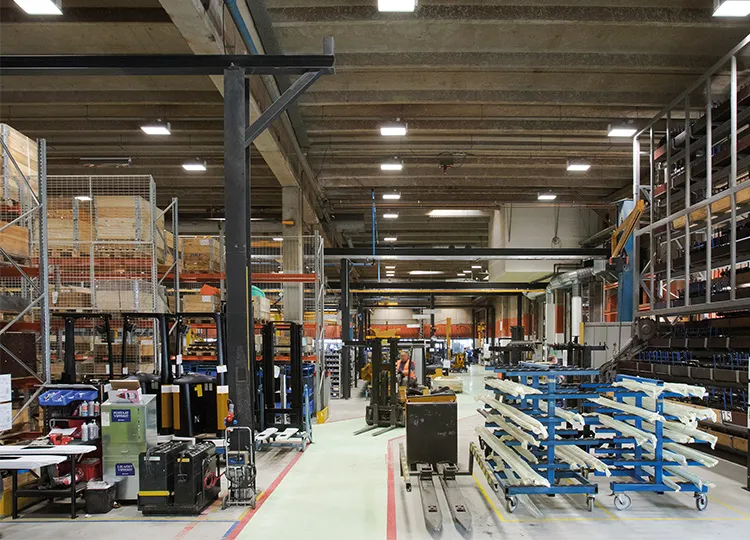
Designing a modern lighting system for warehouses and factories does more than just reduce energy consumption and maintenance costs. More efficient, more ergonomic lighting can make a significant contribution to improving the quality of the working environment, which directly affects workers' comfort, health and performance.
The role of proper lighting
Safe and even lighting is one of the key elements of efficient work. In a poorly lit work area, the risk of accidents increases because workers cannot see their surroundings clearly. Proper light distribution ensures that there are no sudden changes in lighting intensity when someone moves from one place to another.
Workers need to see objects clearly and distinguish colours, and must not be disturbed by direct or reflected light. Poor-quality lighting can lead to headaches, eye strain and even migraines, impairing workers' concentration and productivity. Introducing new, modern lighting technologies can help to reduce these complaints, improving well-being and efficiency at work.
LED vs. conventional lighting systems
When upgrading lighting, the question often arises: what makes LED lamps better than conventional HID or fluorescent tube systems? LEDs undoubtedly prove to be one of the most efficient solutions, as they deliver significant energy savings and long-lasting operation. Although the initial investment may be higher, the lower power consumption and longer service life mean the costs pay for themselves within a few years.
Environmental considerations also favour LEDs: they are characterised by lower carbon dioxide emissions, a longer service life, less waste and the absence of toxic substances. In addition, the low UV radiation of LEDs reduces harmful effects in the working environment.
Checking compatibility
To optimise the lighting system, it is often worth replacing the existing equipment completely. If this is not feasible, old light fittings can also be retrofitted with LEDs. However, attention must be paid to compatibility issues, such as dimming or the effects of reflected light. It is worth seeking expert advice when planning the installation.
LEDs can be switched on and off quickly with no long warm-up times, so they are particularly well suited to use with motion sensors and automatic controls, resulting in further energy savings.
Choosing the right provider
To carry out the lighting system installation, it is worth choosing a provider that offers expert advice and reliable installation. Look for companies with references that offer a long-term guarantee.
A carefully designed and installed LED lighting system can improve the quality of the working environment in the long term, reduce energy use and contribute to sustainable operations.